Showing posts with label Planning. Show all posts

Friday, April 15, 2016

Day -16 : Flippity-flopping On Gear Choices

Now, thats a knife!
Suddenly its sixteen more days until I begin. I am mostly ready now. Mentally and physically anyway. How much does it really take to prepare? Probably less than I have. I tend to be an over-planner which is why this trip is going to be good for me. I think the unpredictable, unknowable aspects are going to be the hardest things for me to deal with. That means that the mental and emotional challenges will probably the most difficult. I noticed today, again, for the... I don't know... millionth? time how much I enjoy routine and doing the same thing over and over again. I come up with an optimized way of going through the day, most people would call it a rut. I am already a little anxious about my resupply package not being at the Post Office, and I haven't even shipped it yet. Throwing me out into the unpredictable variability of a thru-hike,  wow, talk about feeling uncomfortable!

I still haven't completely finalized my gear list. They say your pack weight reflects your fears. With all of the unpredictability I am finding that I have ample opportunity for fear. It's a constant battle to not add a small extra here and there. Before I know it, my pack is a pound heavier. Currently my pack weight is 12 lbs 11.6 ounces, but that is subject to fluctuate up and down a bit prior to leaving. I will update you with my final 'start' weight / list after I have actually left home. There are so many things that could be planned for that, the odds are, they are not going to occur. I am constantly weighing the probability of them and trying to take the least amount of things. One of the things I keep telling myself as I take things off the list is, "I can always have this thing shipped to me if I find I really need it." It seems to be helpful to do that. I happen to believe that fear is one of the greatest enemies keeping people from their dreams and goals. I don't want the weight of my pack to become a factor that causes me to be unable to accomplish my goal. So I deliberate and flippity-flop from dream-crushing fear to irrational optimism, I am not sure if there is such a thing as a 'happy' compromise between the two. I am looking forward to starting for the simple reason that the decision will have been made, the die will have been cast, and for better or worse, I will have to deal with the consequences of my decisions.

It looks as though we are in for some warmer weather for the next week here in California. The snow is beginning to melt. I drive to work each day looking at the Sierras to the east, wind-whipped and white, covered in snow. It looks really cold. A few months from now I will be traversing across the tops of those ridges. The snow will probably be mostly gone, I picture the trail by Tahoe, a section I am familiar from a number of hikes I have made on it.  I wonder what my thoughts will be after I will have hiked one thousand one hundred miles to essentially arrive back where I am now. Seems kinda crazy to even consider it. However, life is the journey, not the destination. Its not about where you are, its about the path you experience as you live out each day. I want to spend more time doing things I love. I feel that this hike will bring clarity to me about what I want and love.

Saturday, February 27, 2016

Day -61 : Canada here I come!

Time is so odd. In any given moment it seems to stand still, yet when you look back it's hard to believe that much time has past. My last post was seventeen days ago, hard to believe. In less than two months I will set off on my epic adventure. Five months of hardship, deprivation, heat, cold, dirt, blisters, snakes, scorpions, bears, mosquitoes, wet feet, freezing nights, broiling days, cooking food over a small stove, sleeping on the ground. Why am I so excited? My wife Kelli considers it torture, she has zero interest in going with me, and there is a part of me that thinks the other part of me might be a little crazy.

I have created packing lists for each of my resupply boxes so as to not miss the important stuff. Then I created a shopping list based on the packing lists. I realize that I will probably get tired of eating some of the stuff on the list, so I will only be buying enough food to get me to Kennedy Meadows. I plan on re-adjusting my menu / packing lists when I get to Mojave.

My first interaction with the Canadian government was a success. They have issued my APPLICATION FOR ENTRY TO CANADA VIA THE PACIFIC CREST TRAIL. They were obviously shouting when they saved the file as the file name is in all caps. I printed it out and vacuum sealed it in a bag to keep it dry.
Yay! I can enter Canada without getting arrested by the Mounties!

Then I read the email to which it was attached:
"*NOTE: You must PRINT this approved - APPLICATION FOR ENTRY TO CANADA VIA THE PACIFIC CREST TRAIL form and keep it with you at all times while entering Canada and within Canada on the PCT.  As secondary option, you may keep your attached electronic approved form in your cell phone." 

I love the Canadians, they are so much more flexible about things. California requires that I print and have in my possession a paper copy of my Campfire Permit and the US Government requires that I print and carry my thru-hiker permit. I have to have and carry my Passport too, so I put my printed copy with my Passport in a waterproof bag and put it into my Steheken resupply box.

I have also been practicing creating videos on my iPhone. I am hoping to be able to post them from the trail, but that is going to depend a lot on cell coverage and if I can get access to wifi at my town stops. I also created a you-tube channel and posted a few of my videos there. You can subscribe to it here: www.youtube.com/channel/UCVOV83PORPIbjJ6da8Be2ug that way you'll be notified everytime I post a new video.

If I get access to a PC at a town stop I might be able to put a video on a post like this:


Shelly and I made a promo video a few weeks ago. I hope to have it posted to my channel in the near future.

Wednesday, April 15, 2015

That Doesn't Sound Like a Vacation

I have never hiked in Southern California. When people ask me where I am going on vacation this year I tell them that I am going to hike for two weeks on the Pacific Crest Trail starting at the Mexican border. I call it desert hiking, although an experienced PCT thru hiker told that the desert doesn't really start till you are in the Mojave which is another hundred miles north. To me this will be desert hiking and I have no experience desert hiking, so I am going to learn this year. My goal is three hundred and fifty trail miles.

Hot, dusty, dry, prickly, windy, parched are words that I think of now that describe my two week trip. From the reports of others who have hiked this section I hear there are lots of rattlesnakes, coyotes and ants. Ants have never bothered me before but I only mention them because others have mentioned them. The last rattlesnake I saw, I ate. That's a different story. I don't plan on eating any more snakes. Then there's coyotes. we have those around the town that I live. Every now and again on a warm summer evening you can here a pack of coyotes catch something. They go into a frenzy of howling and yipping that is creepy. They sound like a gaggle of witches cackling as they dump the bat eyes and newt toes into their steaming caldron of potion. No disparagement intended to any witches out there but I am thinking of the evil step-mom in Snow White, or Hansel and Gretel. Get a couple of those gals together and I bet they'd sound like a pack of coyotes ripping a jack-rabbit apart. But I digress...

Hiking alone in the desert is not what most people I know consider a good time or even an ok time. In fact it is the last thing they would want to do. Which brings me to the question, Why do I want to? I don't know, I don't know why I want to any more than I know that I like peanut butter. For years I didn't like it, then one day I tried it and whamo, I found that I had acquired a taste for something that I never particularly cared for before. It's the same with desert hiking. Although perhaps in an earlier stage. I haven't yet ever hiked through the desert. I am at the place where I am willing to try it to see if I will like it. I anticipate that I will, but that is still an open questions. I can say that I want to enjoy it. I look forward to it, so we'll see.

Had a dream last night that I ran out of water somewhere out in the middle of the desert. There is nothing more miserable than running out of water. It's one of my fears. Hot, dry wind sucking the moisture from my skin as I traverse a never ending series of switchbacks on a trail. Where is the next water? Miles and miles... and I am down to a last swig of mostly hot water... now my water's gone. That is one of my nightmares. Most of the stuff we worry about never happens, so I am going to plan to avoid running out of water and not worry about.

I reviewed Halfmile's new 'unofficial' alternate around the Mountain Fire closure. It looks like it adds another five miles or so to my route. Hey cool, it's the journey, not the destination, right? I wasn't planning on stopping in Idyllwild, but this route makes it easier if I change my mind. In less than two weeks I'll be on the trail. Dodging rattlesnakes, melting in the sun, panting for water... I can hardly wait!


Friday, March 20, 2015

Menu Planning for Thru-hiking

How do I plan a menu for a multi-day backpack trip and be sure that there is going to be enough food without carrying too much weight? For me the planning starts with the number of days for my trip. Then I figure out how many breakfasts, lunches, and dinners there will be. Even though my eating habits change dramatically when I am backpacking, (I am basically eating all the time I am not sleeping), I still find that the ritual of eating at a regular times breaks up my day and gives me a chance to do something else besides walking.

The first thing I do is determine my route and my preferred campsites. Then I figure out the distance between campsites which is the distance to travel that day. Then I divide the number of miles by my estimated speed. I always estimate conservatively. Even though my average pace is about 3.5 miles per hour, I will generally use 2.8 miles per hour for this estimating. This gives me the number of hours I am going to hike for the day. I multiply this time 100 and I get the number of calories I want to eat while I am hiking.


The planning I do is based on the research by Brenda Braaten, Ph.D., R.D. found here: Pack Light Eat Right. I have read through her research and I have adjusted my menus accordingly. I have noticed a big difference in the length of time I able to hike in a day and the way I feel while hiking since I changed my menu to be closer to her recommendations. The author suggests that the main thing to focus on is the number of calories in your food, more specifically fat and complex carbohydrates. Yes protein, vitamins, and such are important, but the main thing a long-distance hiker needs is calories, you are eating for fuel. Then densest form of fuel is found in fat. Protein and Carbohydrates both have 4 calories per gram while fat has 9 calories per gram. Pound for pound, carrying fat over protein and carbohydrates more than doubles the fuel per pound!  The author also explains that you need carbohydrates while hiking and suggests eating about 20 grams of carbohydrates and / or 100 calories per hour. I have adopted this as a guide and basically plan for a snack of about 100 calories of mostly complex carbohydrates and fat every hour.
For example: From the Mexican border to Lake Morena is 20 miles. I divide 20 by 2.8 and round up, This works out to 8 hours of hiking. Then I multiply 8 times 100, which is 800 hundred calories. This means that I plan to eat 800 calories in snacks on that day.

Everyday while hiking I eat a mix of cashews, pistachios (pre-shelled), and almonds. I also eat Almond M&Ms, M&Ms, banana chips, Oreos, Fritos, dehydrated fruit, Power Bars, Clif bars, Poptarts, pretzels, Cornnuts, , etc.

Each morning during breakfast I stuff my pockets with the snacks for the day. Every hour or so I pull out a snack and eat it slowly during that hour. I have found that following this process I can hike 5 or 6 hours straight.

Breakfasts are my intro for the day. I have tried all kinds of different combinations, but I keep coming back to my favorite, Trader Joe's Maple Pecan Just the Clusters granola, Vanilla Instant Breakfast, a couple of ounces of freeze dried fruit, and a Starbucks Via Mocha or Vanilla Latte. I have tried other things, like instant oatmeal or Mountain House Breakfast Skillet in a tortilla. They are tasty and easy, but whenever I have those I end up missing my regular granola and fruit with coffee.

Lunches are a chance to take a break in the middle of the day, to re-charge, rest, and eat something. I like a packet of tuna packed in oil, a tortilla, and a couple of packets of mayonnaise. I also eat beef jerky, Fritos, Nutella, peanut butter, etc.

Dinner always includes a small scoop of Cytomax in 8 ounces of water. This year I am going to go off the Mountain House reservation and have purchased the Chili / Soup mix combo pack from Harmony House. I have also purchased and re-packaged Honeyville Farms meat into separate quarter cup servings in vacuum-sealed bags. I am bringing a bulk quantity of instant rice, top ramen noodles, and instant refried beans. My plan is to combine one of the Chili or Soup mixes with a serving of meat and the starch of the day. I am planning to use the bag the meat is sealed in to combine all the ingredients with about a cup to a cup and a half of water.

The author of  Pack Light Eat Right has a number of recipes. The one that I like best is the recipe for Trail Brownies. I make these up into separately packaged single servings for at least one per day. I eat these for dessert after my dinner. I always bring a few extra to share with my traveling companions.

The result of my planning is approximately two pounds of food per day. The next step is to divide this food into resupply boxes. My goal for resupply is to resupply no more than 4 days apart. I plan to never carry more than 4 days(or eight pounds) of food at a time. I am planning on carrying up to six liters of water. This means that food and water together is going to be about 20 pounds. The heaviest days will be the first day and resupply days. When I add than to my base weight of 11 pounds, the heaviest pack I will be carrying will never be more than 31 pounds and will average around 22 pounds. At that pack weight I plan on being able to travel between 25 and 30 miles per day.

Sunday, November 9, 2014

Desert Hiking Plans

Desert! Hot! Sandy, no water, every plant and rock is out to puncture you and your equipment. Or so I have heard. I personally have no experience hiking in the desert.
What??? Hiking for over thirty five years and you've never hiked in the desert?
That's right, I have never hiked in the desert. A desert newbie, a babe in the cacti. There are miles and miles of desert on the PCT and if I am going to hike the entire PCT I am going to need to know how to hike in the desert. So...

Next year's adventure is to the desert. Two weeks, Three hundred forty two miles of blistering, scorching, sun-baked, dusty, blinding, bliss in the wilderness. I am planning on hiking the PCT from the southern terminus to Interstate 15. Last summer I hiked the John Muir trail plus a few extra miles for a total of two hundred forty three miles in fifteen days. The plan is to hike an additional hundred miles in the same number of days.

I will attend the Annual Day Zero Pacific Crest Trail Kick Off (ADZPCTKO) event at Morena Lake before setting off to push myself further than I have ever pushed myself before. Even though there are not as many high passes as the JMT there is still significant elevation in climbing up and over San Jacinto Peak. I think the hardest part of this trip will be the challenges of finding water and surviving the harsh desert temperature extremes.

One of the most exciting aspects of this trip is going to be meeting the other hikers that will be attempting to hike the entire trail and the trail angels that volunteer their time and effort to assist hikers.

Now that I have set a target I have something to start working towards. For the first time in months I went to the gym and worked out today. What a weakling I have become. A pudgy weakling with skinny arms and a well rounded middle. I am having difficulty lifting my arms and legs they are so sore. It's amazing how much more motivation I feel now that I have set a goal. I find that without a goal I simply have no motivation to get in shape or stay in shape.

I'll be writing more about my plans and the stuff I learn as I prepare. The trip starts at the end of April, 2015. That is less than six months from now! So much to do, so little time...

Sunday, August 24, 2014

It's Bittersweet - The Joy of Hiking mixed with the Sadness of Separation

My friend Jon is leaving. Life is sending him to the Northwest. I am going to miss him. We have decided to share a hike together before he heads off into his new life in the rain of Washington state. I am excited for him and sad for myself. It is not an easy thing to find loyal, trustworthy, and faithful friends in this life, people can be so disappointing. Jon is a shoulder you can lean on, a man who watches your back, a tried and true friend. I know God has great things in store for Jon.

Friday night we will embark on a repeat of my 2013 jaunt from Echo Summit to Donner Summit. The total miles is something around sixty two miles. We are going to attempt to complete it in forty eight hours, This time, unlike last time, we'll have a extra day if we need it. The summer in California has been hot and long (pretty much like it always is). The water situation on the trail will be something we'll need to pay attention to. Last time I ended missing the turn in the trail to Fontanillis lake and ended up wandering in the woods between the Velma lakes for a couple of hours. This caused me to make the foolish mistake of not cameling-up on water prior to hitting the trail to Richardson lake.

I remember jamming through that eight miles as fast as I could go on about a half-liter of water. There is nothing worse when I am hiking than running out of water. Life becomes miserable, my cottony mouth becomes dry and my throat cracks and rasps as I try to swallow. Lips crack and my head gets this dull ache that makes the world seem foggy and distant. The pounding of my heart is in my ears and the sounds of nature become muted and distant. The key to a happy hike is water! Never run out of water!

I am going to use this trip as an opportunity to try some different foods. My dinners have been Mountain House for many years. What I have been doing is buying the two-person pouch and splitting it into two portions. Then I vacuum seal them into two separate bags for two separate meals. I am sick of freeze dried dinners. There are some of the meals that I have come to loath, I only eat them because I must eat them. I have decided that I will try some couscous and some freeze dried refried beans. Not together, as separate dishes. I have also added some Jack Crisps, which look like the cheese that gets stuck to the pan when you are frying up a cheese omelet. Tastes like it too. Jack cheese with all of the water fried out of it. Perhaps a tortilla with beans and Jack Crisps will be like a bean and cheese burrito. With some Taco Bell Fire sauce it might be just like it. At least its different. Add to that some Fritos and trail brownies, dinners suddenly sound more palatable.

A while back I spouted off my opinion of alcohol stoves. One of the great things about being human is the ability to change your mind. In this case my mind has a favorable leaning towards the Caldera Cone by Trail Designs. I ordered one of these stoves last week and it arrived yesterday. Wow, that was really quick service! The stove is well-designed and manufactured. My favorite old Optimus Crux canister stove, with windscreen, lighter, and empty fuel canister weighs in at 11.4 ounces. The Caldera Cone alcohol stove with windscreen, stove, lighter, and empty fuel bottle is only 8.6 ounces. This saves me 2.8 ounces! It is funny to me how excited I am about saving 2.8 ounces of weight.

Perhaps I should consider cutting off the handle of my toothbrush, I always considered that the silly sign of someone who is too extreme in their quest to save weight. My axiom, "You become that which you mock and despise" is proving true once again. I look forward to evaluating this stove option on this trip. In my testing it appears that this alcohol stove burns hotter and more effectively than my previous one thus changing the relative weight and performance comparison between it and a canister stove.

Sunday, June 22, 2014

Lists and a Few Loose Ends

The back of my pack.
One week! It's only seven days before I set off into the wilderness. I finished up a few loose ends yesterday as they came to my mind. My wife, Kelli, asked me if I had them (the loose ends) on a list. Ummm, well no, sorta, I should, "Thats a good idea!" I said. Actually, I have lots of partial lists; lists with a few things written on them. I make each one as I think of things I don't want to forget. For some reason I have difficulty finding the last list I created, so I create another one. What I really need is a list of my lists, so I don't forget one of them.

I do have one list that I have spent a lot of time on, that is my Gear List JMT 2014 page where I have listed all of the stuff in my pack. I want to add the rest of my gear, that is the stuff I will be wearing. For now you can see the roughly twelve pounds of gear I will be carrying. If you have already looked at that page you might by saying, "I thought it was only eleven pounds?" You would be right. I took my microspikes off of the list a while back because they are almost a pound and I really don't think I will need them. However, in reading the blogs of people crossing the passes in the High Sierra, they are saying that there is still snow on them. That was last week, so will there be any snow left next week? I don't know. I do know that I want to hike early in the morning, perhaps by moonlight. Especially the last day when I climb Mt. Whitney. Snow has a tendency to ice-up over night and become super-slippery. So if there is any, I'll be glad I brought them.

Kelli, my wife, has graciously offered to drive me to and from the trail-head. This is really cool and is going to save me a lot of time riding buses from Lone Pine to Yosemite. It will also give us a short mini-vacation together. I have found that a car trip is a good time to have heart-to-heart conversations with your best friend. I am looking forward to our rides together almost as much as the hike itself. It seems like the day-to day routine of living life doesn't leave a lot of time to spend with the people you really care about. It would be super-cool if she liked to backpack because then we'd have lots of time together, but that is not going to happen unless something miraculous and supernatural occurs. I'm not saying it can't happen, but I am not going to sit around wishing it would happen. For now my trips are by myself.

I have my work-out plan for the last week in civilization all set, I really should write it on a list. I am feeling stronger right now than I can ever remember.I went to the gym yesterday and did my weight training routine. I tried to do a sitting military press (not sure if that is what it's called). This is when you sit on a weight bench / chair and lift dumb-bells over your head. Normally I do a standing military press with a bar with free weights on it, so I figured I should be able to lift about the same weight... Wrong! Dumb-bells have a mind of their own! They refuse to work in unison, my right arm was being pulled out sideways while my left arm was trying to reach around behind my head. Sort of like the pose that a G.I. Joe action figure does with his arm stretched out behind him. I quickly realized that the dumb-bells were too heavy. After dropping twenty pounds they seemed a bit easier to lift straight up. Except my right arm was so much weaker than my left. Being right-handed, this seemed really weird. It was then that I noticed that the dumb-bell in my right hand was five pounds heavier than the one in my left. Who's the dumb-bell now?

Laugh in the face of mosquitoes!
This week I will wash my hiking clothes one last time and then spray them with Sawyer Permethrin. This works really well in keeping the mosquitoes from landing on and biting your shoulders and turning them in mini-replicas of the Himalayas. I will spray it on my hat to keep the mosquitoes from biting through my hat band and making a ring of bites across my forehead. I will also spray it on my Smartwool base layer as that is what I like to where around camp in the evening. It's comfortable and breathes well. Mosquitoes can bite right through the fabric, so spraying them makes it so the mosquitoes don't even land on you, it's awesome! So that is one thing on my list. It's probably on lots of my lists.

Saturday, June 7, 2014

Food Resupply on the JMT


The first thing someone asks me when they learn that I am planning to hike the John Muir Trail in thirteen days is, "Are you going by yourself?" To which I respond "yes". The next question is, "How are you going to carry enough food?" The answer is, "No, I am not going to carry 13 days worth of food. I am going to resupply."

I haven't ever planned a hike where I had to resupply, but if I ever plan to hike the whole PCT in one season, which I do, I had better learn how to resupply. This summer's trip on the John Muir Trail is a perfect time to learn. My plan is to resupply twice. When resupplying there are lots of options, all of them require you to stop hiking and do something else.

 When I start hiking in Yosemite Valley I will be carrying four days worth of food. I will have all of it securely packed in a Bear Vault BV500 bear canister. Some people who hike the JMT start with some snacks and water and hoof it as quickly as they can to Tuolumne Meadows, where they have stashed their pack. I don't want to do that. I want to hike the whole trip with all my gear. Call me stupid, but I am going to climb the first four thousand vertical feet out of the valley with a full pack including the aforementioned four days of food. I don't intend on stopping at Tuolumne Meadows but plan to hike another ten miles and camp at the Lyell Fork bridge.

I really only need three days of food. I once heard somewhere that the weight of your pack is directly related to your fears. One of my fears is running out of food. I am actually carrying an extra day worth of food when I start. My first resupply point is at Mammoth Lakes. I plan to catch the shuttle at Red's Meadow near Devil's Postpile National Monument and ride from there into town. Many thru-hikers suggest buying your resupply food in Mammoth Lake. Again, I am ignoring (probably) good advice and not doing that. I am bringing a resupply box with me when I pass through Mammoth Lakes on my drive to Lone Pine the day before I start my hike. I am planning on finding someone in Mammoth Lakes to hold on to my box for me until I come back for it three days later. I will be picking up three more days of food here.

Seven days after I start, I plan on arriving at Muir Trail Ranch. They cater to people who want to stay at their resort, but they also provide a resupply point to thru-hikers. This is really the last 'convenient' resupply point for a south-bound thru-hiker before you get to the remote High Sierra backcountry. I say convenient because the ranch is only a mile or two off the PCT. The other options are long hikes to trailheads where you have to hitch a ride into a town down on Highway 395. I don't have the time to do that on this trip, so Muir Trail Ranch is my spot.

http://www.tomharrisonmaps.com
It's not a cheap spot, they charge a bunch of dollars to hoof your food up to their ranch from the Post Office. They have special rules about how to ship them things, such as you need to ship stuff to them in a plastic bucket. I suppose boxes have a way of disintegrating when they fall off of the back of a horse fording a stream. By the time they fish the box out of the stream it is water-logged and basically falls apart. Not so with a plastic bucket. When it falls into the stream it bounces without getting the stuff inside all wet. Another rule is that you have to tape the handle of your bucket down so that the bears can't pick it up and run off with it.  I guess Yogi and Boo Boo live near by.

There are worries and fears associated with resupply. Especially at a place as remote as Muir Trail Ranch. Like what if my bucket doesn't arrive, or they lose it? That's probably the biggest worry - to be in the middle of nowhere without food. But if I were going to play the What-if game I could come up with at least one hundred other things to worry about. In fact there are just as many things to worry about in my normal suburban life. I basically trying to ignore the what-ifs, except to the extent that I do my best to mitigate the risks. If I started focusing on them, I would stop doing most of what I do now and live a safer, more predictable, might I say 'boring' life.

Tuesday, May 20, 2014

A Singular Inability to Focus

The time of my departure draws nearer and I feel like my thoughts are scattered. There seem to be a million and one different little details that need to be addressed and I find myself bouncing from one to the other without completing any of them.
The first nine miles

Some of the larger things on my list are:
  • Increase workout regimen to include aerobic (bicycle rides) activity and consistent core exercises at the gym.
  • Add routes to way-point file and print out maps of route
  • Complete food list, purchase, and pack same
  • Acquire seal-able plastic bucket for shipping food to resupply point
On top of these there are other things that I don't want to forget so I am creating to-do lists and I now have a list of my lists.

Normally I feel like I get more organized before a trip, right now I feel the opposite. Perhaps it is because this trip is so far outside of my comfort zone. The epic nature of it has me wondering if I will be able to complete what I have started. The trip looms larger in my mind everyday. Especially the first four miles from Yosemite Valley to Glacier Point. Four thousand vertical feet in four miles with four days of food in my twenty-four pound pack. I tried to think of another four to add to the previous sentence, but four fours is probably sufficient. It seems that whenever I sit down and try to focus on a particular task I become side-tracked with trivialities, like how many fours can I fit in a sentence.


Friday, May 2, 2014

Yosemite Weekend - Epilogoe

I can't believe it was a week ago when I was preparing for my weekend in Yosemite. I had planned to write a short 'Lessons Learned' post when I got home, but after the drive I needed a nap. Then I woke up and did the stuff that didn't get done over the weekend. Then I did other stuff and... poof. Here I am at the end of another week.

It's about two months before I head down the JMT. Even though last weekend was cold and wet, I thoroughly enjoyed our hike up to Nevada Falls. I learned where the backpacker's camp was and also where the trail-head is to the Four Mile Trail. My first day hiking is going to be quite a day. I will hike across the valley to the trail-head. Climb four thousand vertical feet to Glacier Point. Once I arrive there I can begin my hike from the trail-head that I have been permitted to use. Then I hike from Glacier Point down to Nevada Falls, meeting the JMT at a junction about a mile before the falls. Altogether its about twelve extra non-JMT miles that are tacked on to my hike.

One of my tests last weekend was to tryout the Mountain House Breakfast Skillet. This meal is a plate of scrambled eggs, peppers, onions, sausage, and hash browns blended together, freeze-dried, and dumped into a bag. The idea is that you reconstitute it with hot water and use it as a filler for a breakfast burrito. Woo Hoo! Yes, that's what I'm talking about. I brought along another one of my tests. A couple of tortillas that I had vacuum sealed over a month ago. They had preserved remarkably well. I draped them over my pot of boiling water for about a minute and presto, a steamed tortilla ready to be filled with Breakfast Skillet goodness. This meal gets my hearty recommendation and I will be adding it to my menu. I will, however, be dividing the meal into thirds as one pouch is way more than I can eat in a single meal. After I divide it, I will vacuum seal each serving, which will take a little under one half a cup of water to reconstitute.

Another test was sleeping in a 40 degree bag and a Cocoon silk mummy liner in cold weather. First off, I was completely warm and comfortable in my new ZPacks 40 degree bag. Along with the bag I purchased a matching Goose Hood for those nights that are colder than normal. It was colder than normal, the weather had predicted nights in the 20s however I don't think it was that cold, the water in the puddles didn't freeze. I would guess it was in the mid 30s and my sleeping kit worked flawlessly. I really like having the separate hood rather than a mummy sleeping bag with a hood. The draw string at the top of my sleeping bag snugs the bag around my neck and the hood allows me more freedom of movement for my head than I ever had with my mummy bag.


Friday, April 25, 2014

Yosemite Weekend - Part 1

The weather has gotten colder overnight. We were hoping to be able to drive to Yosemite without having to drive in snow. That is looking more and more like wishful thinking. The high's during the day are also going to be colder than the lows we've been having here at home at night.

They are saying that there could be as much as eight inches of snow on the ground by the time the storm finishes on Saturday. There are two ways to look at it. You could say, that sounds cold and wet and project from there that you are going to be miserable and cold and it won't be any fun. Or... you could say, that sounds like there may not be as many people as are normally there and the views with the snow on the trees and cliffs ought to be spectacular! 

I am bringing my camera and we should be able to go to many places in the park without encountering mobs of people or long lines. It'll be colder than we are used to but if we prepare as if we are going to the snow it shouldn't be that cold. The coldest part will be at night. It'll give me a chance to test my 40 degree sleeping bag. It seems to me that this will be a pretty good test.

When I hike the JMT this summer I am planning on bringing a ZPacks 40 degree sleeping bag. I am going to combine that with a Cocoon Silk mummy liner. One of the things that I have always found to be very uncomfortable with nylon sleeping bags was trying to sleeping with my skin touching nylon. It feels slimy and sticky, especially if you are less than clean. I hate waking up with my face laying on nylon fabric. I normally sleep in a Smartwool micro-weight base layer so most of my body is isolated from the nylon.

I discovered Cocoon's silk mummy liner's and have greatly increased my comfort in sleeping. Silk, being a natural fiber, is strong, warm, and durable. It adds warmth to my sleep system. Not only that it keeps my body separated from my bag, reducing my need to wash my sleeping bag, while washing the mummy liner is easy and it dries very fast.

Smartwool mirco-weight merino wool is another natural fiber, as a natural fiber it also doesn't absorb odors and is extremely durable. It is as comfortable a cotton, but unlike cotton, it keeps you warm when it gets wet. Not that I want to get wet when I am sleeping. I like the base layer combo so much that I have two sets. One for sleeping in, and the other for wearing during the day.

It will be interesting to see if a 40 degree bag combined with a silk mummy liner and my Smartwool base layer will keep me warm enough. Fortunately, since we a car camping I have a number of fall-back options the best one being that I can cuddle with Kelli. We'll be on the road in a few hours. Right now, though, I am going to Starbucks to get a mocha; one of the benefits of living in civilization.

Saturday, April 19, 2014

Vacuum Insanity

My VacMaster 112
What happens when you give a geek a VacMaster 112? Well, in my case, experiments in the vacuum sealing of backpacking food. Whenever I am talking with someone and I mention that I am planning a two-week jaunt on the John Muir Trail one of the first questions they ask is, "So, what do you eat; freeze-dried food?" I bought the food vacuum in an attempt to expand my options in what I eat. In order to do that I need to determine what works and what doesn't. So I ordered a whole bunch of vacuum-sealing bags and begin my experiments. I have thoroughly enjoyed myself, and the geeky, number-cruncher in me is loving the calculating of the number of M&Ms in one ounce (twenty seven) and other such trivia.
Yum... dinners

It is a generally true rule of my experience that when you open freeze-dried foods, as well as other foods, they become stale the longer they are exposed to air. So my big idea is that if I seal them back up in appropriate portions I can have decent food that isn't stale even after re-packaging it, having it sit around for a month or so, shipping it in a box to a post office along the trail, and hiking with it in my pack for a few days. If I'm right, I'll be able to have stuff still taste good even if it's been a while since I prepped it. Thus, I am experimenting. This year's John Muir Trail hike is an opportunity to try out some of my theories and ideas.

I started with some Mountain House freeze dried dinners. They come in two-serving pouches but I find I can only tolerate one of those servings in one meal. I would rather split it into two separately wrapped meals and then add other courses to my dinner. Idahoan brand mashed potatoes are an awesome second course. They come in a four serving pouch. If I split them into four separate servings then I don't have a partially opened bag of potato flakes flopping around and spreading potato goodness all about.

What about re-packaging dehydrated fruit?
I did that too... and Cytomax, pretzels, banana chips, tortillas, pita-pocket bread, Oreo cookies, Almonds, M&Ms, Pistachios, Granola with powdered milk and freeze-dried blueberries, graham crackers, a home-made mocha using Nestle's Quik, Starbucks Via, and Milkman powdered milk.

When will the madness end? I feel like I have past a threshold of sanity. No air in a bag of food is a good thing... isn't it?


Perhaps some of this food would be better left in it's original container... but I never been able to achieve anything close to a vacuum before now.


The VacMaster 112 chamber sucks the air out of the bag before sealing it. All I have to do is put the food in the bag, put the bag in the chamber and push the button.

Saturday, March 29, 2014

Provisions for JMT 2014 - part 1

There are four different areas of planning when preparing for a thru-hike. They are Route, Logistics, Provision, and Gear. My focus today is on Provision. Provision in this context means figuring out what you are going to eat and when you are going to eat it. I have previously spent some time and blog space preparing for and documenting my route and logistics. From that planning effort I have determined that I will need to have enough food for thirteen days of hiking. I have further broken-down those days into thirteen breakfasts, thirteen dinners, and twelve lunches. I also determined that I will use two resupply points. One at Mammoth Lakes and the other at Muir Trail Ranch. I will divide my food into three different caches: The food I start with when I begin in Yosemite Valley, the food I pick up at Mammoth Lakes, and the food I pick up at Muir Trail Ranch.

In addition to the food I am eating on the trail, I plan on bringing a fresh, locally-purchased lunch on my first day and secondly, having a locally purchased lunch and dinner in Mammoth Lakes on my 'town-day' when I resupply there.

Here is the break-down of the number of each 'trail' meal that I need for each cache:

Cache Breakfast Lunch Dinner
Start 4 3 4
Mammoth 4 3 3
Muir 5 6 6
Totals 13 12 13


After spending quite a few hours reading and digesting (Ha, that's funny) the information in an article published on the web called Pack Light, Eat Right. I have adjusted my plans so that 'Lunch' begins approximately one hour after I begin hiking and ends approximately one hour before I stop hiking for the day. I have calculated my average hiking time per day to be approximately nine hours per day. According to the article I will need about 25-50 grams of carbohydrates every few hours of hiking to keep up my glycogen levels (whatever glycogen is, it sounds important for sustained energy). The article talks about carbohydrates and fat, which is 'better', etc. I learned that carbohydrates and protein have 4 calories per gram and fat has 9 calories per gram. I also learned that with training you can actually train your muscles to burn fat rather than sugar.
This reminded me of a talk by Covert Bailey I watched on PBS years ago where he said you could become a 'better butter burner' that idea has stuck with me since then and this article seemed to confirm stuff I have believed for decades.

Pack Light, Eat Right provides a list of Trail Snacks...  Oh man, look at all the numbers! This caused me to begin my own research into the numbers on the nutritional labels of my favorite trail snacks. I feel a spreadsheet is in order... I began by putting the serving size, the grams of carbohydrates, fat, and protein on the sheet. I rounded the 25-50 grams every few hours to 20 grams per hour as a target for planning. I was a little confused by the article's proposition about eating 25-50 grams of carbs and how to translate that into 'high-fat' snacks for muscles trained to burn fat. I just made some assumptions based on nothing but the idea that 25 grams of carbs X 4 calories per gram = 100 calories. I then created another target of 100 calories per hour. I averaged the two targets and got a percentage that I used against the serving size on the label. I multiplied that percentage against the serving size and got the number of grams of each snack that should be eaten per hour. Once I converted the grams to ounces I was surprised to find that a rough guideline is to simply plan on eating 1 ounce of a snack per hour while hiking. Then using my previous numbers of 12 days X 8 hours (average) per day = 96 hours = 96 ounces of snacks.
My analysis of my favorite snacks

The high-fat snacks have about half the carbohydrates suggested by the article but have more than twice the calories. Then I selected the number of servings that I want of each, trying to balance the number of high-fat snacks with the low fat ones. The green boxes are my targets for the snack types. The spreadsheet shows my preferences and also calculates that the resulting weight of my 'lunches' is 6 lbs  7oz.

All of these numbers and calculations are rough approximations and simplify the process of determining what and how much food to bring. I still need to finish my breakfasts and dinners; I think they will be easier to determine but I'll leave that for a different post.


Saturday, March 22, 2014

The Food Vacuum

I have spent some time this week planning my menu and resupply strategy for my upcoming JMT hike. One of my challenges has always been how to package my food effectively and store it between the time I purchase it and the time I eat it. A lot of the food I buy in larger quantities and then I end up storing the leftover amounts in zip-lock bags and using it on a future trip. The problem is that it ends up not being very fresh and is often stale. So I end up tossing the left-overs from previous trips and buying new.

The other related challenge is how to package my food so that it stays fresh and organized in my pack, especially if I am using a bear canister. There are a myriad of ways that it could be done, from dumping everything together to leaving everything in it's original packaging. My preference is to repackage everything. Putting the food for each meal into a separate gallon size freezer bag. So I have a breakfast bag, a dinner bag and a lunch bag.
Food Pouch
Some food is best if it remains in it's original packaging. I am thinking of freeze dried foods, and specifically the Mountain House dinners that I tend to use. It seems that freeze-dried food gets stale pretty quickly after opening. My practice has been to buy the entrees in the easy to find standard pouch containing 2 servings I typically don't like eating the entire contents in one sitting so most of the time I open the pouch and divide the contents into two sandwich-sized zip-lock bags. For dinner I normally pour hot water into the bag, let in steep, and eat right from the bag. I collapse the bag and put it in my trash bag when done, thus keeping my dish-washing to a minimum.

Wow 10 servings
I have considered creating my own meals from separate ingredients. I would like to buy freeze-dried food in bulk containers but how would I store the stuff I don't use on a particular trip? The pricing is a little better if you buy in bulk, but only if you don't end up throwing away the remainder because it got stale.

I followed OTC Craig's PCT hike last year I noticed that he used a vacuum sealer for his food and thought, "What a great idea.". Ever since then I have been mulling over the idea and thinking how many different problems it would solve. 

VacMaster VP112
After a whole bunch of research over the last few months I have finally made it a reality and bought a vacuum sealer. I am pretty excited about it. I decided to go with a chamber style sealer because it seemed to me to be a more flexible option. The unit I purchased is a VacMaster VP112. I have not actually received it yet and will give you an update once I've had a chance to use it.

Wednesday, January 15, 2014

Adventures in permit reservation land.

One of the things that I enjoy about backpacking is planning the trip. In the present case, it is the plan I am putting together for my John Muir Trail trip this summer. One of the helpful planning tools I use is Excel. I use it to put together my itinerary and schedule.

A plan should always have a clear mission statement. To hike the John Muir Trail in ten days this summer. Technically though I will be hiking eleven days. I am not at all sure that this is even possible so I am doing everything I can do to make it possible. At two hundred and twenty three miles in length, my average miles per day will need to be over twenty miles. I am hoping to keep my pace above three miles per hour, assuming I can keep up that pace I will be hiking around seven hours per day. On the positive side, there are over fourteen hours of daylight during the time I am planning. I think it would be cool to summit Mt Whitney in time to see the sun rise. I also think it would be cool to hike under a full moon in the pre-dawn darkness. My plan is to summit on Saturday, July 12, 2014.

In order to turn my plan into reality I needed to submit a reservation for a permit. These can be made up to one hundred and sixty eight days in advance. Since I know that Yosemite Valley is one of the prime vacation destinations for people looking for a wilderness experience, I expected that people would be eager to get their permit reserved. I just didn't realize how eager.

I was filled with anticipation when I faxed my Wilderness Permit Application. I filled it out weeks ago in eager excitement for this day. I envision the trip, I picture myself getting the permit. I can see myself starting on my hike. My application was faxed within fifteen minutes of the official moment when you can request an application. The official moment is five pm on the day before the day that is one hundred and sixty eight days before the day you want to start your trip. At five fifteen the Wilderness Center had my application and I had butterflies in my stomach.The application instructions make it clear that they will reply back via your supplied email address within one or two days.

The next day at ten am I checked my email. My heart leaped within when I saw an email from Yosemite with a subject of Yosemite Wilderness Permit Reservation. "This is it!," I thought. "Thank you for your reservation request. We are sorry to inform you..." Sorry for what?? How can this be? "...has been rejected..." Ouch, such strong words. Do they not like me? Have they confused me with some dangerous felon? "Your requested trailhead is full..." Full? Within fifteen minutes of five pm on the day before the day one hundred and sixty eight days before the day I want to start, which so happens to be a Wednesday, in the middle of the week, probably the slowest day of the week? And I have been told that it is FULL. I had visions of stacks of hikers crowding the trailhead. Standing room only!

"...we do not have space for a group your size..." for one? Really? "...rejected  due to insufficient space..." for ONE PERSON??? "

"...if you requested a reservation for two or more people and there is only space for one, you were rejected." Ouch again, 'rejected' is such a strong emotionally-charged word! Did they even read my application?? It was clear that I was requesting a permit for ONE person. This is obviously a form letter. Did a human being even look at my application? Could they read? What am I to do? "You may wish to apply again..." Really? what are my chances? Do I really want to go through the process of REJECTION again?

The whole process was a very deflating, spirit sapping, experience. No matter what other good things happened, I had an underlying feeling of loss and confusion. There was a phone number on the bottom of the email that you could call, that I tried to call. Every time I called, the line was busy. What is the problem? Why is the phone busy? I wasn't sure what I was going to do. I have spent a lot of time planning this trip.

I went back to the web site and found a page called Trailhead Information. It lists all of the trailheads and the reservable quota for each. The trailhead I selected only had six open reservable spots. I imagine the guy who put in a reservation for a six person trip is pretty happy with his email.

Late in the day I thought I would give the phone number one more try... It's ringing! Who was I calling? Did I call the wrong number? "Yosemite Conservancy, can I help you?" I was so flustered by the fact that the phone rang. That I didn't even know what to say. I felt like Ralphie in A Christmas Story. "Ho, Ho, Ho, and what do you want for Christmas little boy?" I couldn't think, I stuttered, I tried to remember why I was calling.

I have to say, Martin was so patient and helpful. He explained to me that it really doesn't matter if you fax your application at 5:00 pm the night before or 6:50 am the day of. All of the applications are collected and randomly shuffled. I asked him if there were any days or trail-heads that were not full. He said, "Oh sure, there are lots of openings, are you flexible on your start day?" Why, sure I am, but what day is open, do I have to guess? Martin helpfully looked for openings, he recommended alternate trail-heads and provided customer service par excellence. It became obvious to me why the phone was busy all day. 

By the end of the call, I had my reservation completed. I understood the process a whole lot better and I am back to preparing for an epic trip through some really cool country. Bottom line, I now have my permit reserved. I will have to modify my plan slightly, but the extra miles will be spectacular. Did I mention that Yosemite is a prime vacation destination for those wanting a wilderness experience? It is and I am.

Sunday, December 22, 2013

An ounce of prevention is worth a pound of cure

For many years I have used the same gear and have grown comfortable with how it works, its features, and its limitations. Not unlike other parts of my life, things grow comfortable, normal, and routine. My friend Al uses the phrase "culture settles fast" to describe group dynamics, but I find the phrase to be true in many areas of my life. I like routine and normal, I cultivate habits and practice routines, doing things the same way over and over until I no longer have to spend much mental energy doing things, I can focus on thinking about other things while living in routine.

One of the big downsides of living in routine is that you miss the NEW. You become blind to things outside of your own comfort zone. I think that was one of the things that frustrated Jesus in his interactions with the Pharisees. The had got so used to their religious routines that when something outside of their paradigm, like the Messiah they had been waiting for, showing up into their lives, they couldn't see or hear him.

I find it to be a healthy practice to periodically go back and question my assumptions and re-visit those decisions that I have previously made. With these thoughts in mind I began to research my shelter. For a number of years I have used a bivy sack and a tarp when I am soloing. The combined weight of my bivy sack and tarp is 15.3 ounces. This was significantly lighter than the 22.7 ounce two-person Henry Shires Tarp Tent (Squall) that I used if I was sharing a shelter.

There were four downsides to my shelter;
  1. It was more difficult to get into and out of, 
  2. The bug netting on my bivy sack is up-close and personal, like right in your face. The bug-free zone is quite small and confining. 
  3. The tarp works great but takes some practice to get it setup properly, especially in windy conditions. 
  4. This combination also requires a warmer sleeping bag in that there is quite a bit of air movement underneath the tarp and the bivy sack sits in contact with my sleeping bag, leaving no insulation value. When I used the two-person tarp tent I was amazed at how much warmer it is "inside" even though the only wall is gossamer-thin mosquito netting. It slowed the air movement considerably so I experienced a warmer temperature within the tarp tent than with a tarp alone.

Based on those downsides I wanted to find something that was 1) lighter than I have with my bivy / tarp combo, 2) would give me more bug-free zone, and 3) would be warmer. In October 2013 settled on the Zpacks Hexamid Solo Tent without the beak. The tent has a wrap-around bug net that goes underneath you and your gear and you put your groundsheet inside and on top.

This caused me to re-evaluate and weigh my current groundsheet which is an old piece of house wrap. It weighs a mere 5.2 ounces. Zpacks sells a Cuben fiber groundsheet the comes in at 2.7 ounces. Wow, If I bought the groundsheet I could save another 2.5 ounces.

I got my tent in November and set it up on my lawn. I found that it easily met all of the criteria I had set out to accomplish and at 12.8 ounces for both groundsheet and tent would save me about 7.7 ounces.

All was good until early December when I began the same re-evaluation of my sleeping bag. I have been using the same bag now for over ten years. I know it well, I have been pleased with it's performance and it's still clean and in excellent condition. I have a Mountain Hardware Phantom 32 bag which weighs a mere 23 ounces. Way less than most bags you'll find at REI. In my research I came across OutdoorGearLab.com's Ultralight sleeping bag review. I saw that ZPacks's 20 degree bag was rated as the warmest bag for it's weight.

Not only was it the warmest for it's weight, it weighs less than the bag I have now. I began thinking, this is a twenty degree bag, I have a thirty-two degree bag. I recalled that when I had originally bought my bag I went from a zero degree bag to a thirty-two degree bag. I recalled the fear I had of freezing to death in the mountains because my bag wouldn't be warm enough. In the many, many cold nights in the mountains since then there have only been a few times where my bag wasn't warm enough. One time I was cold enough that I pulled out my emergency "space" blanket, tucked it under the side of my bag, and draped it over the top of me. I found that I was instantly warm.

Since then I have added a 3.8 ounce Cocoon mummy liner to my sleep setup. My purpose was to provide a barrier between my typically filthy body and my difficult to wash sleeping bag. I found that not only did my sleeping bag stay cleaner, but I gained a few degrees of warmth to my sleep system.

With the mummy liner, the warmth of a tent, and the insurance of my "space" blanket, I feel I no longer need a thirty-two degree bag. So the idea of a twenty-two degree bag, even though lighter, didn't make sense to me. I found that ZPacks makes a 40 degree bag that would be much more along the lines of what I need. Not only is it lighter than the 20 degree bag, It is almost 11 ounces lighter than my bag.

Like Alice falling down the rabbit hole, I found myself falling into more and more weight savings with every turn. I started with questioning my shelter and now I am questioning my bag. Where will the madness end?

Well, not yet because as I looked at this new bag I found that it had continuous baffles, meaning I could shift all of the down to one side of the bag. The point is that down is not that great of an insulator if your are crushing it underneath your body weight. I have known this for years and because of this switched from a Therm-A-Rest inflatable mattress to a Z-Rest closed-cell foam mattress. The r-value (insulation value of the Z-Rest is 2.6 which was much better than the inflatable one I had. Well, wouldn't you know it, those clever folk at Therm-A-Rest have come up with a new NeoAir XLite mattress that is lighter than my ZRest and has a higher r-value to boot. I could increase the warmth and comfort of my sleeping pad and save 2.4 ounces at the same time.

So, I decided to get the 40 degree bag. While visiting ZPacks website I found that they had just introduced a new tent. This tent has a sown-in floor of Cuben fiber and a killer design with a door that closes down to provide bomber rain protection. After lying in the Hexamid I had purchased without the beak I could easily see that the suggestions on the website of shifting positions under the tape during the rain would be given and that even though the tent is well ventilated it would provide minimal warmth because the front was so open. So even though the Solplex is a little heavier, the better rain protection and warmth it will provide is more than worth it. I emailed Zpacks about the tent I already had and the one that I would rather have and they were happy to exchange it. What a great company.

So now I will have a tent with a sown in floor. I began thinking how dirty tent floors get when you set them directly on the ground. So I went back to researching groundsheets and discovered that something called cross linked polyolefin has become the bellwether lightweight material for groundsheets. Some have even used this material to make a tarp! That is still outside my comfort level but I was intrigued about using it for a groundsheet. I went to my local Home Depot and didn't find the window insulation kit that the guys on the forum were talking about. I then went to Lowes and success! I was able to pickup a Frost King V75 window kit with a 62" X 210" piece of cross linked polyolefin in it. I cut it in half both ways and now I have four 31" X 105" groundsheets. So now I have a groundsheet that weighs 1.4 ounces.

Here's a table showing the weights of each of gear item:

Before After
Sleeping bag 23.1 12.3
Shelter 15.3 14.6
Groundsheet 5.2 1.4
Sleeping Pad 10.4 8

54 36.3


17.7 ounces of weight cut from my base weight

It is funny to me that I have cut 17.7 ounces from my base weight by going through this process. I remember doing this the last time and was sure I had gotten my weight to the lightest I could get it. Now I have improved my warmth and, increased my bug-free zone, and reduced my base weight all at the same time. Normally the first two will always increase the last one.

This is just the most recent example of how challenging my assumptions has led me to a better place. In this case it means not having to carry around over a pound of extra weight that would be keeping me less warm and comfortable than I will now be.
Sunday, December 8, 2013

Planning for the John Muir Trail in 2014

The John Muir Trail starts in Yosemite Valley and ends at the top of Mt Whitney. I have only ever hiked about  ten miles of its two hundred eleven mile length. That hardly qualifies as a John Muir trail hike, so for all intents and purposes I haven't hike it, yet. I am thinking that this might be a fun trip this summer. It looks like I might not be the only one who thinks so as you have to make reservations in advance.

One of the challenges of this thru-hike is how to get to and from the ends of it. It's like a smaller version of the full PCT hike. I will include a resupply or two in the middle to experience that and I will be hiking in the opposite direction of most of the PCT hikers so perhaps I'll meet a few of them.
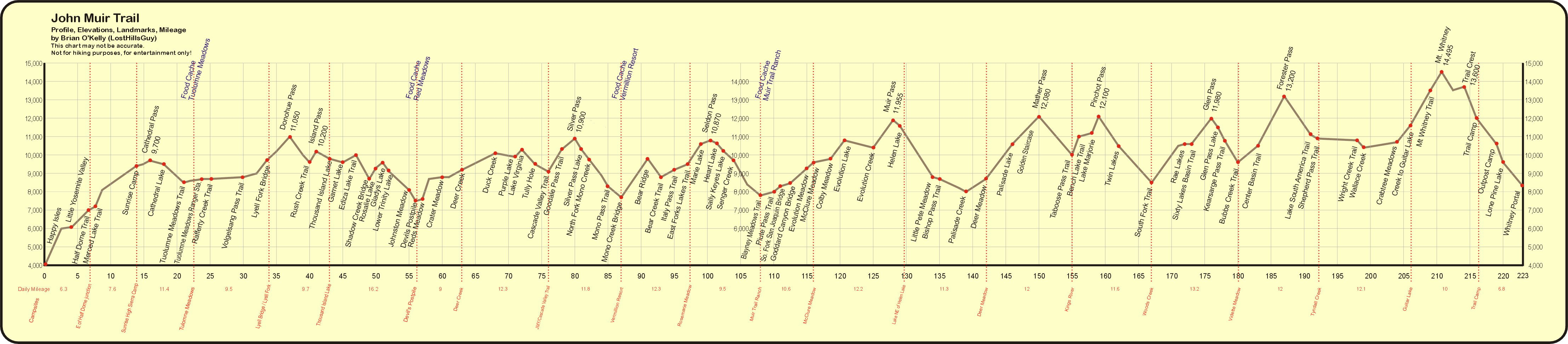
I am wondering if planning for a twenty-one miles-a-day pace might be too optimistic. It is all above eight-thousand feet with strenuous climbing up and down passes that are over ten thousand feet. Mount Whitney is over fourteen thousand feet. I figure it is only a plan, and I think it is a plan with an aggressive schedule. The worst case is that I end up hiking slower than I want to. It just seems to me that the middle of summer has around sixteen hours of daylight which seems like plenty of time to hike twenty-one miles. My plan calls for me to do the whole hike from Yosemite Valley to Whitney Portal in eleven days. Currently I have a single resupply planned for Vermillion Valley Resort with a short 'rest' day planned for that day.

What I don't know about is the snow conditions and the snow-melt conditions. According to those that have been there, the crossings of some of the creeks and passes can be quite challenging in the earlier part of the season. That being said, a later date is probably a safer bet than an earlier date. However the earlier date will allow me to experience a typical PCT thru-hiker's conditions. That is if any particular year could be considered 'typical'. I am leaning toward the earlier date as it seems that it'll be more challenging than the later. I am thinking and planning all of this now because the reservation process. I can reserve my permit one hundred and sixty eight days in advance which means January for a July trip and February for an August trip.

Logistics is another challenge. Since it's a thru-hike, when I finish I won't be anywhere near where I started. So how will I get to the starting trail-head and get home from the finish trail-head? I will have some shuttling to do unless someone were to drive me to and from the start and finish. I really don't anticipate having any volunteers to drive the four hours to my drop-off point and the six hours to my pick-up point. Even if my wife wanted to do that, I don't know if I want her to have to drive all that time, both trips being round-trips.

I think driving a vehicle to Lone Pine and then riding the buses to Yosemite Valley is what I am going to do. In order to hit the bus-stops at the right time I think I am going to over-night in Mammoth Lakes. I will end up in Yosemite Valley around noon, which means I probably want to arrive the day before I start hiking. I can stay in the hiker camp that first night for free. After I pickup my permit I might have a little time to do some sight-seeing in Yosemite Valley, which is an awesome place to see the sights. All-in-all this should turn out to be quite an adventure.

Saturday, October 26, 2013

Route and Resupply Planning

Half Mile's map of Kearsarge Pass
I did some planning for my PCT hike in 2017 today. I am using Craig's PCT Planner. I had started using this a while back when I was reading Wired's blog about her PCT trip in 2011. I could not remember my password for logging into Craig's planner. I tried every password I could think of, no success. So I tried to use the forgot my password feature and did not get any response. Finally I used the Feedback feature and emailed Craig giving my name and login (which I did remember) and my email address. I explained that I couldn't remember my password. I didn't know how long it might take for Craig to get back to me. It was pretty cool, he emailed me right back and informed me that I had used a different email address, doh!

It is lots of fun to go through the different resupply scenarios and refer to Yogi's PCT Handbook  to review the different resupply points. I have a much better idea of my pace after the 2 day trip I took from Echo Summit to Donner summit. I am using that pace as a baseline to calculate my days on the trail and zero days. It's quite fun and engaging.

I am using Half Mile's maps  to review the trail at different points to determine if I want to resupply at different points. It looks to me that the diversion over Kearsarge Pass to the Onion Valley trailhead is a key resupply point because of the distances and difficulty of the trail in that part of the Sierras. Even those it adds an additional 15 miles of hiking and an unknown hitch-hike down to Independence, it is better than the alternative of carrying all of the extra food to reach a more distant resupply point. I am considering taking a serious zero day in either Independence, Lone Pine, or Bishop. I am imagining swapping out the weight of the extra water that I will need to be carrying through the deserts of Southern California for additional days of food to make it through the remote high-country of the Sierras. I also have decided to climb Mt Whitney will I am in the area as PCT hikers are authorized to do that as long as they climb and descend it from the West side. That adds another day and 17 miles of hiking. This whole process is an interesting and fascinating project, I am really enjoying it.

On a different note, I joined the PCTA this week and made my donation to support their efforts to keep and protect the PCT. Maybe I'll even join one of their trail maintenance projects next summer. I am grateful to all of the people who have done so much to make this trail possible for me and I want to it to be around for my grand-kids in case they ever decide to follow in ole grand-dads footsteps.

Wednesday, September 25, 2013

Sixty two in two?


I am planning a trip to see if I am able to sustain two long 30+ mile days back to back. I am wondering if I may be a little insane, why do I want to do this? After bailing out two days early on my trip to the North Cascades I have been hankering for a hike that really pushes me.
Lake Tahoe
Sixty two miles of High Sierra adventure

I have never hiked thirty miles in one day in my life. I can remember two times when I hiked over twenty miles in a day and both days I was pretty tired by the end of the day. In both of those instances it was the final day of the hike and I slept in my own bed that night. This time I will hike about thirty one miles, camp-out, then hike another thirty one miles.

My plan is to hike from Echo Summit on Highway 50 to Donner Summit on the Pacific Crest Trail. Most of the terrain is between 7,000 and 9,000 feet in elevation. I copied an image from Google Earth using Half Mile's PCT Tracks to show my proposed route.

I don't know if I can do this and I am quite unnerved by the whole idea. Most of my life I have stayed within the bounds of what is reasonable and attainable. This plan is outside of my comfort zone.

I am keeping an eye on the weather as rain or snow is not something that I am going to contend with and I will throw out the whole plan if there is precipitation in the forecast.